Israeli Rejectionism: A Hidden Agenda in the Middle East Peace Process by Zalman Amit & Daphna Levit
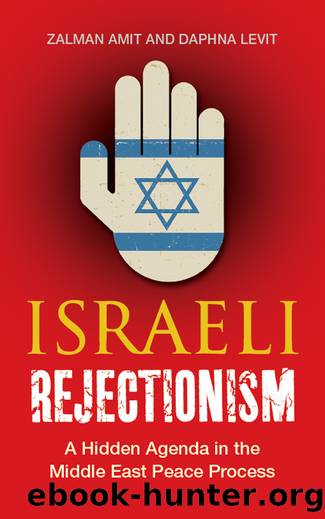
Author:Zalman Amit & Daphna Levit [Amit, Zalman & Levit, Daphna]
Language: eng
Format: epub
Tags: Peace, Political Science, Middle East, History, General
ISBN: 9780745330297
Google: M2vfSAAACAAJ
Goodreads: 11307127
Publisher: Pluto Press
Published: 2011-03-15T10:24:10+00:00
8
THE PLO AS A PEACE PARTNER?
A growing recognition that the Palestinians in the occupied territories were a political entity onto themselves made the Jordanian option, and others like it, no longer viable. Israel had to come to terms with the reality of the PLO as the only legitimate force representing the Palestinians for the foreseeable future.
In 1992 after Yitzhak Rabin became Israelâs prime minister, the unquestioned assertion that Arabs understand only the language of force, and if the principle of force does not work, you should use more force, was becoming suspect in Israel. More Israelis had come around to the view that the resolution of this lingering conflict must be political, by means of a negotiated solution with the Palestinians and the PLO. Although many in the Israeli leadership found the prospect of talking directly to the PLO distasteful, they could no longer avoid it. In January 1993 the Knesset repealed the law forbidding contact between Israeli citizens and members of the PLO, which had been enacted by a Labor government and was in effect for six years prior to its repeal. One peace activist, Abie Nathan, actually sat in jail for violating this law.
The recognition of the PLO as an inescapable negotiating partner paved the initial path to the negotiations between Israelis and Palestinians that led to the Oslo Accords a few months later. But it also became clear that any political solution attained through negotiation would have to involve compromise. The Palestinian compromise had already been made clear well before Oslo. After 1967 the best hope for the Palestinians was a state on 22 percent of Mandatory Palestine, according to the boundary known as the Green Line. The nature of the Israeli compromise for peace was not at all apparent.
Yossi Beilin, a Labor Party leader and the driving force behind the initial Oslo negotiations, stated in an interview on Israeli radio that everybody knows what is required from Israel to provide the minimum acceptable to the Palestinians: a return to the pre-1967 borders, the dismantling of the settlements, and the establishment of East Jerusalem as the capital of the Palestinian state. The question is whether we Israelis are willing to pay that price. No serious Israeli leader has ever publicly denied wanting peace, but peace meant many different things to them. Seventeen years have passed since the Oslo Accords, the first formal peace agreement between Israel and its Palestinian neighbors. Since then Israel has had six prime ministers, each with a unique version of peace and of Israelâs possible compromises for peace. And over the years there have been many confrontations, many deaths, and much bloodshed. The Israeli leadership must not have understood, or not wanted to offer, the minimally acceptable solution to the Palestinians.
OSLO
The First Intifada which began in 1987 persisted for six years despite Israelâs immense efforts to end it.1 The failure to stop this uprising led many Israelis, including several Labor Party leaders, to the conclusion that the conflict could not be resolved militarily.
Download
This site does not store any files on its server. We only index and link to content provided by other sites. Please contact the content providers to delete copyright contents if any and email us, we'll remove relevant links or contents immediately.
The Secret History by Donna Tartt(19088)
The Social Justice Warrior Handbook by Lisa De Pasquale(12190)
Thirteen Reasons Why by Jay Asher(8910)
This Is How You Lose Her by Junot Diaz(6887)
Weapons of Math Destruction by Cathy O'Neil(6280)
Zero to One by Peter Thiel(5802)
Beartown by Fredrik Backman(5754)
The Myth of the Strong Leader by Archie Brown(5507)
The Fire Next Time by James Baldwin(5446)
How Democracies Die by Steven Levitsky & Daniel Ziblatt(5219)
Promise Me, Dad by Joe Biden(5153)
Stone's Rules by Roger Stone(5088)
A Higher Loyalty: Truth, Lies, and Leadership by James Comey(4964)
100 Deadly Skills by Clint Emerson(4925)
Rise and Kill First by Ronen Bergman(4789)
Secrecy World by Jake Bernstein(4753)
The David Icke Guide to the Global Conspiracy (and how to end it) by David Icke(4720)
The Farm by Tom Rob Smith(4513)
The Doomsday Machine by Daniel Ellsberg(4490)
